




MEETING WITH PROFESSOR SIMONA IAMMARINO
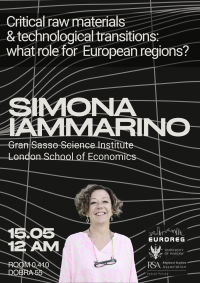
This was one of the key points made by Professor Simona Iammarino, Professor of Applied Economics at the Gran Sasso Science Institute and Visiting Professor at the London School of Economics and Political Science, who on Friday delivered the lecture “Critical raw materials & technological transitions: what role for European regions.” Professor Iammarino is a leading scholar working at the intersection of economic geography, innovation, globalisation, multinational corporations, and regional development. In 2024, she received the ERSA European Prize in Regional Science and the Giacomo Becattini Prize of the Italian Society of Economics and Industrial Policy. Last week, she paid EUROREG a four-day visit as part of the RSA 60th Anniversary Seminar.
The lecture addressed one of the most pressing issues Europe is faced with today, i.e. how can we pursue technological and green transitions when these transitions depend on critical raw materials whose extraction is deeply territorial, environmentally costly, and politically sensitive?
The main takeaways included:
1. Critical raw materials are located in specific places and tied to specific communities, infrastructures, firms, and risks. Professor Iammarino argued that there is nothing more situated than natural resources and yet regions are still missing from policy frameworks.
2. Europe’s mining potential is unevenly distributed. Mining projects and resources tend to be concentrated in specific regions, such as parts of the Iberian Peninsula, Scandinavia, Central Europe and Poland. And Europe trails behind China not only in terms of the resources themselves but also when it comes to tapping into the raw materials potential of the rest of the world, in particular Africa.
3. Europe needs stronger interregional and international networks. A purely national or fragmented approach puts Europe’s global position in jeopardy. Critical raw materials, innovation, and technological transitions depend on flows, cooperation, and value chains that cross borders. Regions that are not connected to these networks may be left behind.
We would like to take this opportunity to extend our gratitude to Professor Iammarino for visiting us and delivering an inspirational lecture on one of the hottest topics of the recent months!
Event description:
The seminar aims to explore how current technological shifts and the growing geopolitical significance of critical raw materials reshape regional development paths in Europe. By bringing together researchers and members of the RSA community, the event will provide a platform to discuss how EU regions can position themselves within emerging global value chains and how policy frameworks can enhance regional resilience and competitiveness.
Bio:
Simona Iammarino is Professor of Applied Economics at the Gran Sasso Science Institute (GSSI), and Visiting Professor at the London School of Economics and Political Science (LSE). Her main research interests lie in the following broad areas: multinational corporations, globalisation processes and regional and local impacts; economic geography of innovation and technological change; regional and local economic development and policy. In 2024 Simona was awarded the “ERSA European Prize in Regional Science”, and the “Giacomo Becattini” Prize, Italian Society of Economics and Industrial Policy (SIEPI).
Simona is co-editor of the Journal of Economic Geography and was co-editor of Regional Studies. She has a long-term experience, both as Principal Investigator and as Senior Researcher, in externally funded international research projects, and in consultancy projects for various international organisations (e.g. EU Commission, OECD, United Nations, WIPO, ADB) and government agencies.
Where and when:
Friday, 15.05.2026, 12:00
Room 0.410, Wydział Neofilologii, ul. Dobra 55 (Faculty of Modern Languages, Dobra Street 55, Warsaw)
Organizers:
Regional Studies Association – Polish Section
Centre for European Regional and Local Studies (EUROREG) University of Warsaw
The event is held as a Regional Studies Association 60th Anniversary Seminar and is co-funded by RSA.
